Pool leak detection · Gauteng

Pool Leak Detection in Gauteng: Four Methods, One Team and a Repair That Stays Fixed

Pool leak detection in Gauteng should end the guessing, because a pool that keeps losing water is telling you something and every wrong guess gets expensive. Crispy Pools finds hidden leaks in concrete and fibreglass pools across Gauteng using four methods: visual inspection, dye testing, pressure testing and gas leak detection. Then the same team repairs what we find, so nothing gets lost between the diagnosis and the fix, and you stop topping up and start saving.

You get a clear answer, a written quote for the repair and a re-test to prove the loss has stopped. Chris personally supervises major projects and is involved from quote to handover, and if the pool has to be emptied we can store your water in our own bladders, free on suitable projects. The assessment and quote are free, with honest advice and no obligation.

  • Free on-site assessment
  • Written quote
  • No obligation

Want to check it yourself first? The free bucket test below takes a day and tells you whether you have a leak or just a hot week.

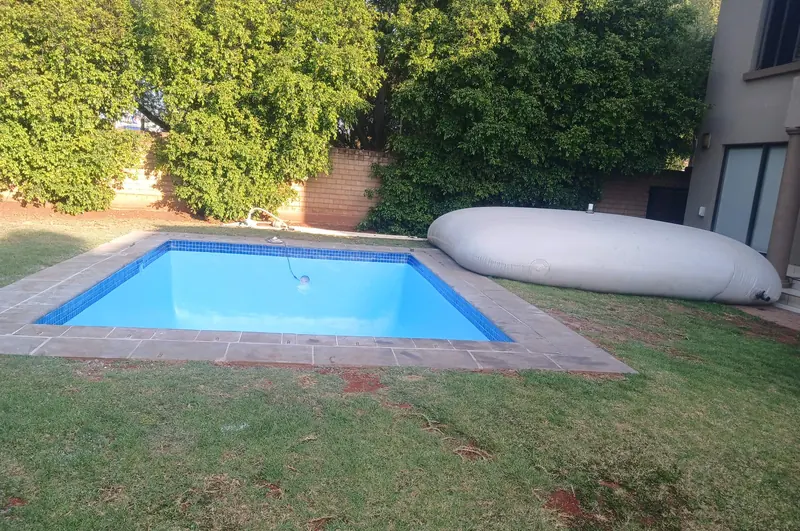
Pool leak detection: empty square pool with a light blue finish, a dark blue tile band and grey sandstone coping, with a large grey water storage bladder lying on the lawn beside it
Gauteng
Your free quote in three steps
  1. 1
    Message ChrisSend your suburb, a short description and a few photos.
  2. 2
    Free on-site assessmentWe look at the pool and give you honest advice on what it needs.
  3. 3
    Written quoteA clear scope and price, with no obligation.
Get a quick estimate

Two minutes, no obligation.

info@crispypools.co.za
Chris personally supervises major projects and is involved from quote to handover.
Building since 2008Backed by Crispy Construction
Chris supervises major projectsQuote to handover
Every project warranted5-year fibreglass, 3-year Marbelite
Free on-site water storageOn suitable projects
Free quotes, honest adviceNo obligation

Is it a leak or just evaporation? The 24-hour bucket test

A Gauteng summer takes a few centimetres a week off an uncovered pool, so a falling level is not always a leak. A bucket of pool water loses water to evaporation just as the pool does, while a leak affects only the pool. That makes this free test a reliable first check. Do it on a calm day, with no swimming and no backwashing.

Fill the bucket

Fill a bucket with pool water to about 5 cm and set it on the top step, partly submerged.

Mark both levels

Mark the water level inside the bucket, then mark the pool level on the outside of the same bucket.

Leave it for 24 hours

Keep the pump on its normal schedule, and don't swim, backwash or top up.

Compare the marks

If the pool has dropped further than the bucket, it is leaking.

Repeat with the pump off

A bigger loss with the pump on suggests plumbing, and a bigger loss with it off suggests the shell, the skimmer or a fitting.

If the water always stops at the same height, the leak is usually at that height, often at a skimmer, a light or a crack. Switch the pump off if the level falls below the skimmer, and don't drain the pool to hunt for the leak, because an empty concrete pool can be pushed up or cracked by groundwater pressure. For more on why pools lose water, read our guide to a pool losing water.

Signs your pool is leaking

Constant topping up, or a level that keeps dropping, points to something more than evaporation. Watch for these signs:

  • You are topping up far more often than you used to.
  • The water falls and then stops at the same height every time.
  • The level keeps dropping right down to the floor.
  • The pump draws air, loses prime or runs dry.
  • Paving or soil near the pool stays damp, or the lawn is soft.
  • There are visible cracks, or water seems to escape around fittings.
  • The cleaner stops after a few minutes, which can point to an underground pipe.
  • A previous repair didn't solve the problem.
  • Your water bill has crept up with no other explanation.

How we find a hidden pool leak

We treat a leak as an investigation. We read the evidence first, then use the method that suits the pool and the suspected source, which avoids unnecessary digging and guesswork. No single test finds every leak, so we combine them.

Visual inspection

We start with a close look at the fittings, the skimmer and weir, the returns, visible pipework, the surface, any cracks, the equipment area and the paving, walls and soil that show moisture. Visible evidence often points to the likely source.

Dye testing

A controlled amount of dye is placed beside a suspected point and its movement is watched. If water is being drawn out at that spot, the dye shows it. It suits cracks, fittings, returns, weirs and skimmers.

Pressure testing

We isolate each plumbing line, such as suction lines, return lines and underground pipework, and test whether it holds pressure. A line that loses pressure has a fault, and a line that holds can be ruled out, which separates a plumbing leak from other causes of water loss.

Gas leak detection

Where the pipework is buried, concealed or hard to reach, gas introduced into the isolated line escapes at the fault, and specialised equipment picks it up at the surface. It points to the affected area before any excavation begins.

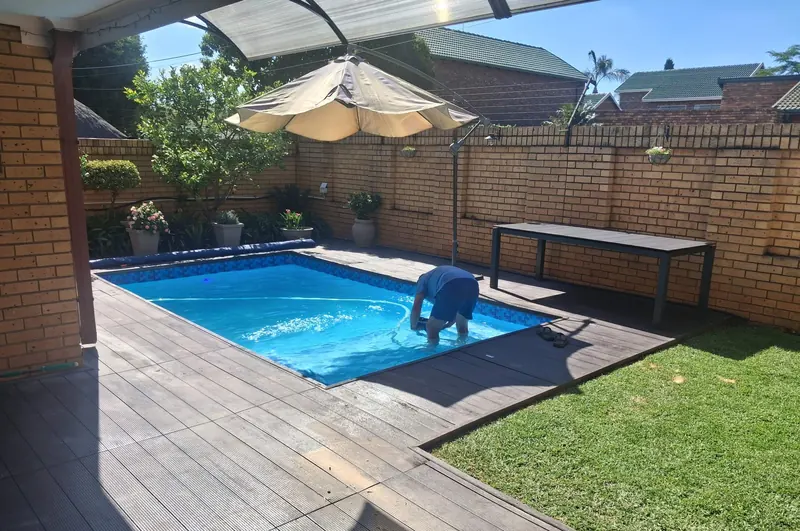
Technician working in a small rectangular pool surrounded by dark decking, with a patio roof and umbrella above
Hands-on work in the poolSmall pools get the same care: the surface, the fittings and the water checked properly. Read more about pool repairs across Gauteng.
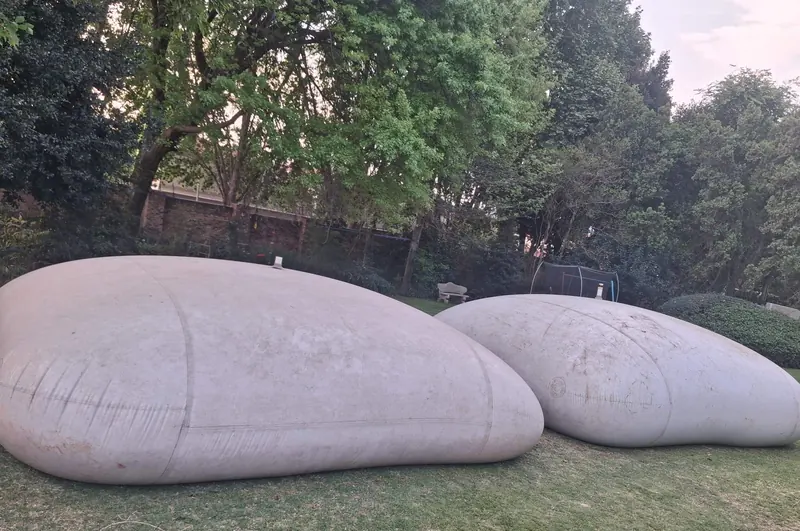
Two large grey flexible water storage bladders on a lawn among garden trees
Your pool water stays on siteTreated water is stored in bladders we own while the pool is emptied for the work.

Where leaks hide, and how we fix them

Finding the leak is the first half of the job. The second half is repairing the actual fault, so it stays fixed.

Underground plumbing

Suction and return lines under paving, lawn or concrete can fail unseen. We repair or replace the affected section and open only what we need to.

Fittings

Skimmers, weirs, returns and light niches are re-sealed or replaced, depending on condition. Damp, soft paving beside a skimmer often means a cracked weir body.

The pump and filter area

Leaking unions, valves and seals are repaired or replaced, and we separate them from leaks in the pool itself.

Why a leak matters more on some Gauteng ground

A pool holds many thousands of litres, and a leaking pool sends that water into the ground beside your home. How much that matters depends on what lies beneath it.

Dolomite

Parts of Tshwane, Ekurhuleni and the West Rand sit on dolomite, a rock that can dissolve and form cavities when water gets into it. In those areas, water entering the ground is the usual trigger for sinkholes, so a pool leak is worth fixing early. Not every property sits on dolomite, and you can't assume yours is fine. We repair pools and we are not geotechnical engineers. If you see sinking ground or an unexplained hole, keep people away and call your municipality and a geotechnical engineer.

Clay

Other plots sit on expansive clay that swells and shrinks with the seasons. Water from a leak softens and moves the ground around the shell, and cracks widen as the shell works against it.

Older pools and estates

Older pools have usually been patched before, which makes the source harder to find and a clear diagnosis more valuable. In estates and complexes, we follow the access, security and working-hour rules, and we keep any opening of paving or landscaping to a minimum.

How it works

You get in touch

Send your suburb or estate, a few photos and your bucket test result on WhatsApp for a first opinion.

Site inspection

We look at the pool, the equipment and the surrounds and agree a plan.

We investigate

Inspection, dye, pressure and gas testing narrow the loss down to one point. Most inspections take a few hours, depending on the pool.

A clear answer and a written quote

You receive the findings and a quote for the repair before any work starts.

We repair and re-test

The job ends when the loss has stopped.

If the pool has to be emptied

Some leak repairs need the pool emptied. Where the project is suitable, we use storage bladders that we own to hold your existing water while we work. That avoids discarding a large volume of usable water and cuts the municipal water needed to refill the pool.

See our free pool water storage page.

  • Your treated water is kept, not thrown away.
  • You avoid a large municipal refill.
  • Your chemical balance carries over.
  • Storage is free on suitable projects, with no third-party hire delays, and we confirm it at your assessment.
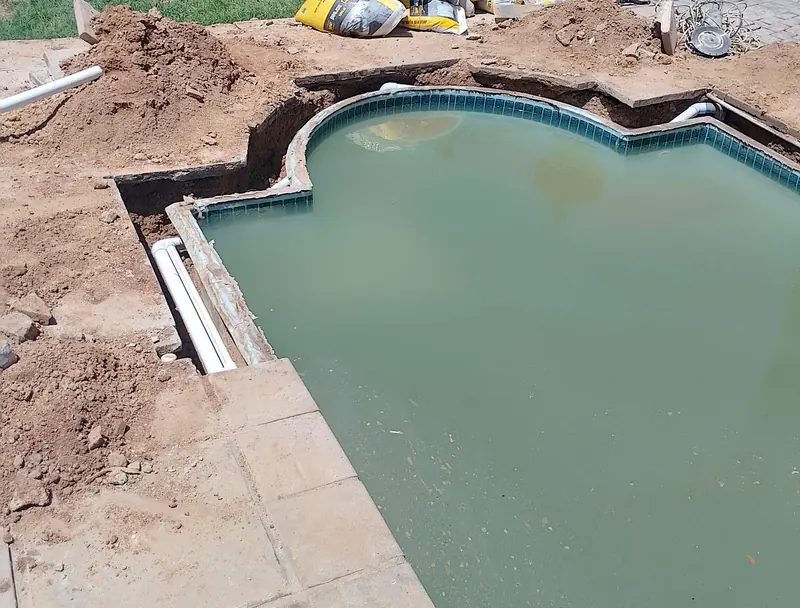
Swimming pool with green water and its old coping removed, a trench dug around the edge with white pipework showing, and bags of cement and heaps of soil beside it

The old edge comes off first

The old coping is lifted and the edge is opened up before the new work goes in. Read more about pool renovations in Gauteng.

What leak detection costs

The cost depends on how the leak behaves, where it is likely to be and how many methods are needed to pin it down. We assess first and give you a written quote, so you know the price before work begins. A leak that is found early is usually a smaller repair, and a larger job, such as resurfacing, is only recommended when the pool needs it. For typical figures on the larger jobs, see pool prices in Gauteng.

When it is bigger than a leak

We don't believe every leaking pool needs a full renovation. If the problem can be properly repaired without extra work, that is what we recommend. If a pool has several underlying problems, a larger project may make more sense, and we say so. See pool repairs in Gauteng and pool renovations in Gauteng.

Why Gauteng pool owners trust Crispy Pools to find the leak

  • We find it and we fix itOne team handles detection and repair, so nothing gets lost between the diagnosis and the work.
  • Backed by Crispy Construction, building since 2008That includes difficult repair and restoration projects.
  • Four methods, read togetherVisual inspection, dye testing, pressure testing and gas detection each add a piece of evidence.
  • Evidence before excavationWe establish the likely location before anything is opened.
  • Chris personally supervises major projectsand is involved from quote to handover.
  • We take over half-finished and badly done poolsWe assess what is there, correct what is wrong and complete the job properly.
  • Free on-site water storage on suitable projectsWe own our bladders, so there are no third-party hire delays and the saving is yours.
  • Estate-readyWe follow each estate's contractor access, security and working-hour rules.
  • A written handover guideEvery project ends with a care guide covering warranty details, a bucket test and a maintenance checklist.
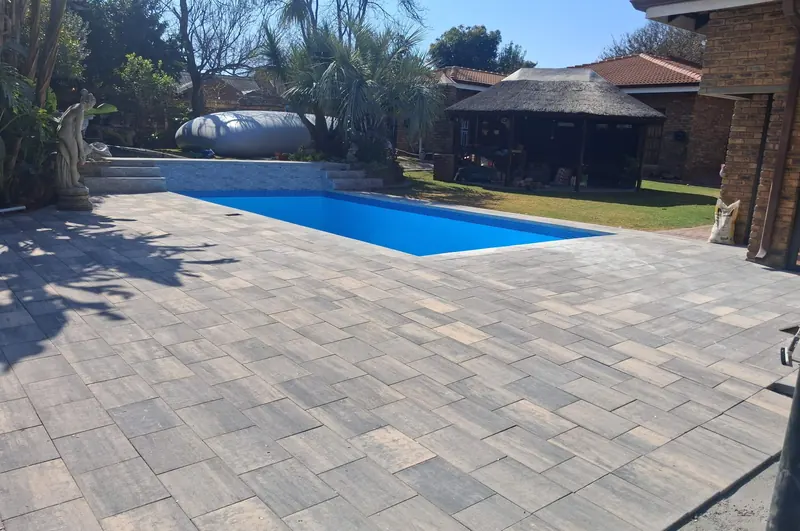
Newly paved patio around a freshly finished pool, with a water storage bladder showing behind the palm

Water stored on site while the work is done

The bladder holds your treated water, so you do not pay for a full refill.

Pool leak detection across Gauteng and beyond

We find pool leaks in Pretoria, Centurion, Midrand, Sandton, Randburg, the East Rand and the West Rand, and in the outer towns of Bronkhorstspruit, Hartbeespoort, Bela-Bela, Polokwane and Makhado. Choose your area below for a page with local detail, or message us if you aren't sure where your suburb falls.

Pool leak detection in Gauteng: your questions answered

Why is my pool losing water overnight?

A loss that continues overnight, when no one is swimming and the sun is down, often points to a leak instead of evaporation. Run the bucket test above to confirm.

How do I know if it is a leak or just evaporation?

Use the 24-hour bucket test. If the pool drops further than the water in the bucket, it is leaking. A level that always stops at the same height, a pump that draws air or damp ground near the pool also point to a leak.

How much water loss is normal?

A small, steady amount from evaporation is normal, especially in a hot summer. A continuous loss that has you topping up every few days is not.

Can you find underground pool pipe leaks?

Yes. We combine pressure testing and gas leak detection to trace faults in buried or concealed suction and return lines, including pipework behind raised sections and support walls.

Do you use pressure testing and gas leak detection?

Yes, along with visual inspection and dye testing. We choose the methods that suit your pool and the suspected source.

Do I need to empty my pool for leak detection?

Not always. Many leaks are traced with the pool full, and we empty it only when the investigation or the repair needs it.

Do you have to break paving to find a leak?

Usually we narrow the leak down first, so any paving or landscaping we open is opened for a clear reason and kept to a minimum.

How long does leak detection take?

Most inspections take a few hours, depending on the pool. Buried pipework or a deep structural leak can take longer, and we give you a realistic timeline once we have assessed the pool.

Do you repair the leak once you find it?

Yes. We repair plumbing, fitting, structural and surface-related leaks and then re-test to confirm the loss has stopped.

Can a leak be fixed permanently?

Yes, if it is properly diagnosed and repaired. That is why we find the real source before we recommend any repair.

Is a leaking pool a problem for the ground around my house?

It can be. Water escaping from a pool gets into the ground, and some Gauteng ground is sensitive to that. We repair pools and are not geotechnical engineers. If you see sinking ground or a hole, keep people away and call a geotechnical engineer.

Can you check estate and complex pools?

Yes. We follow each estate's access, security and working-hour rules.

How much does leak detection cost?

We assess first and give you a written quote before work begins, so you know the price up front.

Where we work

Pretoria pool leak detectionFinding and fixing hidden leaks in Pretoria, using four methods and one team.
Centurion pool leak detectionFinding and fixing hidden leaks in Centurion, using four methods and one team.
Midrand pool leak detectionFinding and fixing hidden leaks in Midrand, using four methods and one team.
Sandton pool leak detectionFinding and fixing hidden leaks in Sandton, using four methods and one team.
Randburg pool leak detectionFinding and fixing hidden leaks in Randburg, using four methods and one team.
East Rand pool leak detectionFinding and fixing hidden leaks on the East Rand, using four methods and one team.
West Rand pool leak detectionFinding and fixing hidden leaks on the West Rand, using four methods and one team.
Free quote

Book your free Gauteng pool leak assessment

The longer a leak runs, the more water reaches the ground and the bigger the repair grows. Chris and the team will find the cause, explain it in plain English and give you a written quote, free and with no pressure.

  • Free on-site assessment
  • Written quote
  • No obligation

For a head start, send your suburb or estate, a photo of any damp or sunken area, a photo of the pump room and your bucket test result. We can usually tell you what we think is happening before we visit.

WhatsApp Chris Now!Call Chris Today: 076 328 9545Get a quick estimateinfo@crispypools.co.za

Serving Pretoria, Centurion, Midrand, Sandton, Randburg, the East Rand and the West Rand.